Chimney maintenance guide
When does a chimney need repointing?
Gaps between the bricks or bits of mortar falling from your chimney are worth checking. Repointing means carefully removing damaged mortar and replacing it with a suitable new mix; it does not mean rebuilding the chimney.
This guide explains what you can notice safely from below, when another repair may be needed, and what affects the cost and disruption. Repointing can help with rain entering through failed joints, but it is not an automatic leak cure.
Genuine Cheshire Pointing archive photograph: a chimney before repair in Cheshire, not a completed Staffordshire job.
Key takeaways
- Missing or very loose mortar may need replacing; age or a slightly weathered appearance alone is not enough.
- A damp chimney breast does not prove the outside mortar is the cause.
- Loose bricks, displaced pots or a leaning stack need prompt attention, not a routine pointing assumption.
- Ask what the price includes for safe access, mortar renewal and any separate chimney or roof repairs.
What can you spot safely from the ground?
The stack is the part of the chimney above the roof. It takes wind and rain from several directions, so its mortar may wear faster than the joints lower down your house. Look from a safe distance, using your phone's zoom if useful. Do not climb onto the roof, lean a ladder against the chimney or stand beneath falling material.
Notice whether gaps are limited to a few joints or spread across the stack. A closer professional inspection can then separate damaged mortar from sound areas worth keeping. Soft lime mortar on an old chimney is not automatically defective, and a shallow recess is not on its own a reason to replace every joint.
Open gaps or deeply worn joints
Dark gaps between bricks, obvious missing sections or mortar that has worn well back can leave the stack more exposed to rain. Photograph the whole chimney as well as the visible patch so the repair discussion is not based on one isolated joint.
Mortar fragments or damaged bricks
Record where debris has appeared, without going into a possible fall area to collect it. Flaking brick faces and broken bricks need attention too: new mortar cannot replace a missing brick face. Debris from above calls for prompt advice because the source may be loose masonry, not just worn pointing.
Cracks, a changed shape or displaced pots
A new lean, bulge, substantial crack or pot that has shifted is not a normal repointing problem. Keep people clear below and seek prompt professional advice; a structural engineer may be needed. Do not try to push, pull or remove anything yourself.
A chimney needs more than a new mortar finish
Cheshire — original project archive
Genuine photographs from the Cheshire Pointing project archive; Staffordshire Pointing is part of Cheshire Pointing Group Limited. This is not a Staffordshire project.
The first photograph shows damaged upper brickwork and broken mortar around decorative chimney pots. The later photograph shows renewed upper courses and a new mortar bed while the repair is under way. Cracks in the pots remain visible; the later view is not presented as a fully finished or safety-certified chimney.
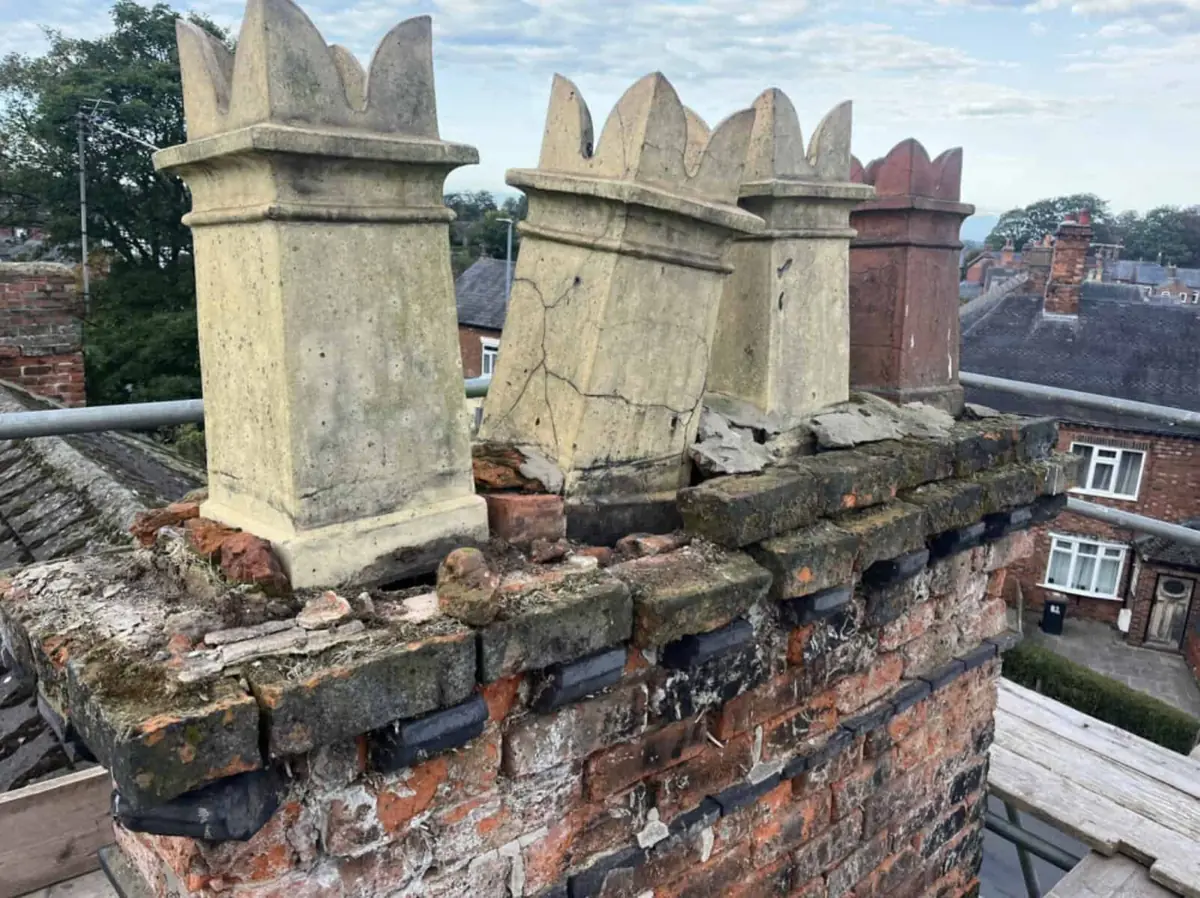
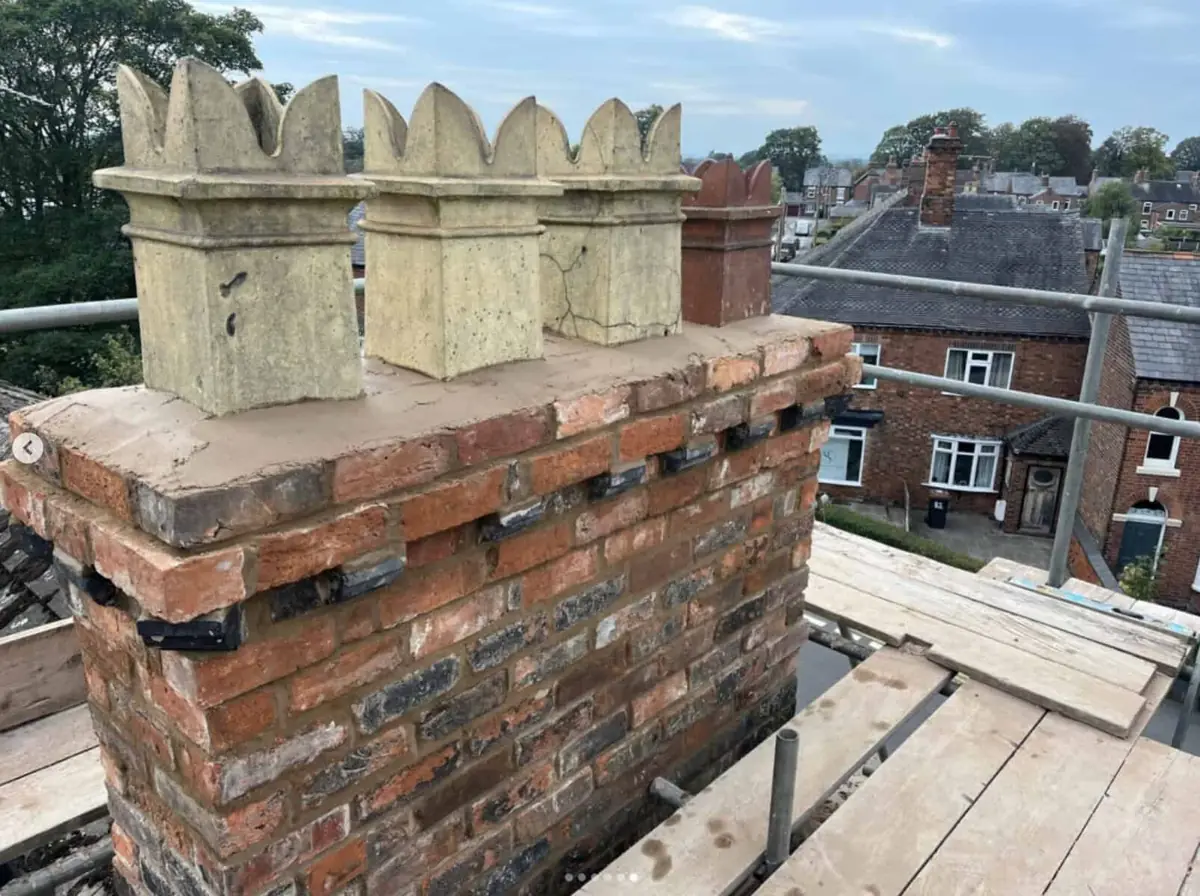
What this example shows: Pointing the joints and repairing the chimney top are different jobs. Ask which bricks, pot supports and roof details need attention, and what remains to be done. These photographs do not identify the mortar mix or certify a flue or appliance.
Read the full Cheshire — original project archive case studyWill repointing stop a chimney leak?
Only if failed mortar is part of the cause. Water can also enter at the flashing — the weatherproof seal where the chimney meets the roof — or through defective flaunching, the sloping mortar around the pots at the top. Nearby roof coverings and open chimney pots may also need checking.
The chimney breast is the part projecting into a room. Damp or brown staining here can come from condensation and soot deposits inside a poorly ventilated, disused flue, not just rain getting through outside joints. The flue is the passage carrying smoke or exhaust gases upwards. Tell the contractor whether the chimney is used and whether marks follow rain, cold weather or appliance use.
Ask for the cause to be investigated before accepting repointing as the answer. External mortar work does not check or certify a flue or appliance as safe. Flue and stove questions need a suitable specialist; gas appliance or gas-flue work needs a Gas Safe-registered engineer, not DIY work.
Does the whole chimney need doing?
Not necessarily. A few failed joints may suit a local repair if the surrounding mortar and bricks are sound. If joints are badly worn across several sides, wider repointing may make more sense. The decision should follow the condition of the stack, not simply its age or how much is visible from one window.
Ask which areas need work and why. Unnecessary removal of sound mortar risks damaging the brick edges, particularly on older chimneys. Rebuilding a damaged section is a different job and should be explained separately.
A few gaps, with no obvious change in the stack's shape
What it might mean: Local mortar renewal may be enough, subject to a closer check of the surrounding joints and bricks.
What to do: Send safe photographs and ask whether a patch repair is suitable, rather than assuming the whole stack needs repointing.
Damp indoors but the visible joints look sound
What it might mean: Roof details, the top of the chimney or moisture inside the flue may be involved.
What to do: Describe when the damp appears and ask for the likely water source to be checked. An active leak needs prompt attention.
Loose material, a lean, bulging or a displaced pot
What it might mean: The chimney may need structural or other urgent repair advice, not mortar renewal alone.
What to do: Keep people away from the area below and seek prompt professional help. If falling masonry creates an immediate danger, contact emergency services.
What happens during chimney repointing?
The repair starts with an inspection and an agreed plan for the mortar, brick condition and safe access. These are the main stages to discuss with a contractor; they are not a promise that every chimney needs the same treatment.
Check the chimney and agree the repair
Identify which joints have failed and whether brick repairs, top details or flashing need separate work. Confirm what is included before damaged mortar is removed.
Set up access and protection
Arrange a safe working platform and protection for the roof and areas below. Agree how debris will be contained and how doors, paths, windows or neighbouring areas will be kept clear.
Remove failed mortar carefully
Take out damaged mortar to a suitable depth and clean the joints, avoiding damage to the brick edges. Smearing a thin layer over loose old mortar is not a substitute for proper preparation.
Fill and finish the joints
Use mortar suited to the existing bricks and the chimney's exposure. On older stacks, a small trial can help agree its colour, texture and finished shape before the rest is done.
Protect new work and finish up
Fresh mortar needs protection from rain, frost and drying too quickly in wind or sun. Agree the clearing of debris, removal of access equipment and any aftercare advice, rather than assuming these are included.
Will there be scaffolding, noise and dust?
Chimney work often needs scaffolding or another suitable working platform. Even a small patch can be awkward to reach safely. Stack height, roof slope, fragile roof coverings, conservatories and space around the house all affect the access plan. The cheapest-looking ladder arrangement is not a reason to compromise safety.
Removing old mortar can be noisy and dusty. Ask how dust and falling debris will be controlled, which windows should stay closed and whether you should move a car or garden furniture. Establish whether scaffolding will affect a doorway, driveway or your neighbour's access.
You may be able to remain at home during external work, but confirm any restrictions and whether a fire or appliance must be left unused. Agree this with the appropriate specialist where needed. Ask about the working days, how long access equipment may remain and what happens if the weather delays mortar work; there is no reliable standard duration for every stack.
What affects the price of chimney repointing?
The amount of mortar to replace matters, but access can be a substantial part of a chimney job. A few joints on an easily reached stack are a different job from repointing every side of a tall stack above a steep roof. A third chimney may need brick replacement or repairs around the pots and roof junction as well. Compare those jobs by what is included, not just the visible size of the chimney.
Before accepting a quotation, ask for these details in writing. If another defect is found once access is in place, agree how extra work and its cost will be discussed before it goes ahead.
- Which sides and joints will be repointed, and which sound areas will remain?
- What access equipment is included, for how long, and are roof and ground-level protection covered?
- What mortar and finish are proposed, and is a trial included where appropriate?
- Are damaged bricks, pots, flaunching and flashing included or priced separately?
- Does the price include waste removal, clearing up, access-equipment removal and VAT where applicable?
Older, listed or shared chimneys: what should you check?
Many older chimneys need a suitable lime mortar rather than a hard cement mix. Lime mortar can let moisture escape through the joints and weather in preference to the bricks. A mix that is too hard can shift damage into the bricks instead. The choice should suit the existing materials and exposed roof position; do not specify a mix just from the house's age.
If your home is listed, speak to the local council's conservation officer before work starts. Listed Building Consent is required for work affecting its special architectural or historic character; do not assume that calling it a repair makes it exempt. In a conservation area, check with the council what controls apply to your proposed chimney work.
A stack on a boundary or serving adjoining homes may be shared. Raise this early with the neighbour and confirm ownership, repair responsibility and any access agreement or party-wall requirements before booking work. Do not assume every pot serves your home.
Common questions
What homeowners often ask.
Can you repoint just one side of a chimney?+
Yes, where the damage is local and the other joints are sound. The whole stack still needs checking so a small repair does not overlook failed mortar or damaged bricks on a less visible side.
Can chimney repointing be done without scaffolding?+
Sometimes another suitable access method may be possible, but it must allow safe inspection and work. Height, roof layout and the areas below decide this — not just how small the mortar patch looks. Ask the contractor to explain the proposed arrangement.
Will repointing cure a damp chimney breast?+
Only where failed outside mortar contributes to the damp. Flashing, top details, water entering the flue or condensation can need a different remedy. Record when the mark appears and have the cause checked before choosing the repair.
Is the strongest mortar best for an exposed chimney?+
No. Mortar must suit both the exposure and the existing bricks. A very hard mix can damage softer old bricks. Ask why the proposed mix is suitable, and whether a trial is needed to check the finish.
Does an unused chimney still need maintenance?+
Yes. Its brickwork is still exposed to weather, and a disused flue still needs appropriate ventilation to help keep it dry. External repointing does not replace checks of its top details or ventilation. Do not simply seal every opening.
How long will the work take?+
Ask for a programme based on your stack and access plan. A local repair and a full-stack job need different amounts of work, and separate brick or roof repairs add to it. Weather and protection of fresh mortar affect timing; scaffolding may remain beyond the days spent repointing.
Sources behind the advice
Where to read more
We’ve used the following guidance for the repair, conservation and safety advice in this article. These organisations are references, not the authors of this page.
- The Society for the Protection of Ancient Buildings (SPAB)Chimney maintenance
Why older chimneys are especially exposed to weather and why difficult access can lead to neglected maintenance.
- Health and Safety ExecutiveWorking at height: A brief guide (INDG401)
Workplace guidance on preventing falls, including risks from ladders and fragile roofs; it is not DIY roof-access advice.
- Historic EnglandOpen Fires, Chimneys and Flues
Traditional chimney damp, ventilation, flue and appliance considerations, and the importance of retaining significant historic features.
- Historic EnglandRepairing Walls of an Older Home
General guidance on matching brick and mortar repairs, addressing damp causes and seeking structural advice for movement warning signs.
- The Society for the Protection of Ancient Buildings (SPAB)Repointing
When historic mortar needs repair, retaining sound joints, suitable replacement mortar, trials and weather protection.
- Historic EnglandListed Building Consent
Checking with the local conservation officer and obtaining consent before work affecting a listed building's special character.
Your brickwork
Not sure what needs doing? Start with what you’ve noticed.
You do not need building vocabulary to get in touch. Send your postcode, a photograph showing the whole chimney and roofline from the ground, and a closer view only if it is safe. Tell us what you have noticed, when it started, whether it is changing and whether the chimney is in use or shared.
Photographs help start the conversation, but a closer inspection may be needed to decide the repair. Prefer to talk? Call 01625 920 888. Staffordshire Pointing aims to respond to website enquiries within 48 hours; if masonry is loose or falling, keep clear and seek prompt safety advice rather than waiting for an enquiry reply.